Change WiFi Network Name
How To Change WiFi Network Name (SSID): A Complete Router Guide
Your WiFi name which they say is also your sticker. However, if your network is still transmitting a default name like “TP-Link_4A20,” “NETGEAR47,” or the model number of your router, renaming will help identify and manage your wireless network by changing it to something understandable.
This guide covers how to set your WiFi network name (also known as SSID) through a router web interface or mobile app. We’ll also be discussing D-Link, NETGEAR Orbi and TP-Link and ASUS routers, what happens after you change the SSID and how you can prevent common trouble with no connection. Change WiFi Network Name (SSID).
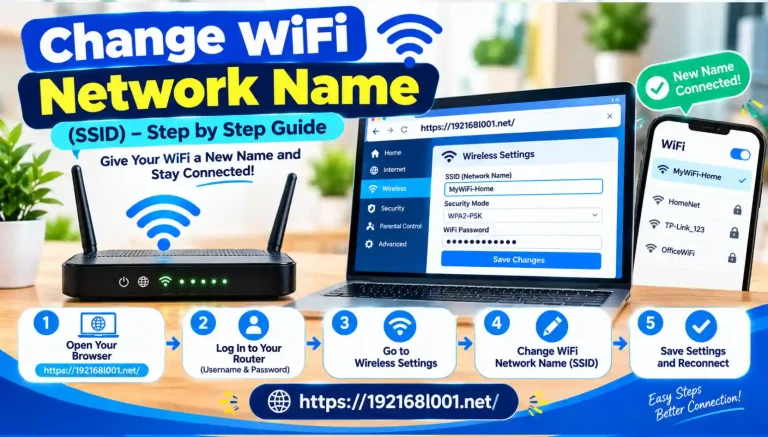
What Is a WiFi Network Name (SSID)?
Service Set Identifier (SSID) Put simply, this is the name that will be used in public for your wireless network. When you open WiFi settings on your smartphone and see names like “HomeWiFi”, “Office_5G” or “NETGEAR82”, these are SSIDs. When you set up your new router, the manufacturer or Internet service provider normally provides a default network name. The default SSID can also be found on a label located at the bottom or back of the router.
You gain no Internet connection by changing your SSID. All it does is rename your wireless network as seen by both users and devices.
Why Should You Change Your WiFi Network Name?
Changing default name (+8 Ways to make it dummy-proof Home / Office WiFi. Now, consider an apartment building with a handful of neighbors who all use routers from the same manufacturer. To illustrate, if your router is unedited, you might see networks called “TP-Link_128F,” “TP-Link_2E42,” and “TP-Link_964A.” A customized name will instantly tell you what network yours is.
This can also make it easier to identify different networks when I have many in my home, office, guest area or even a multi-router setup.
Names like HomeNetwork, FamilyWiFi, or Office_Main are normally better.
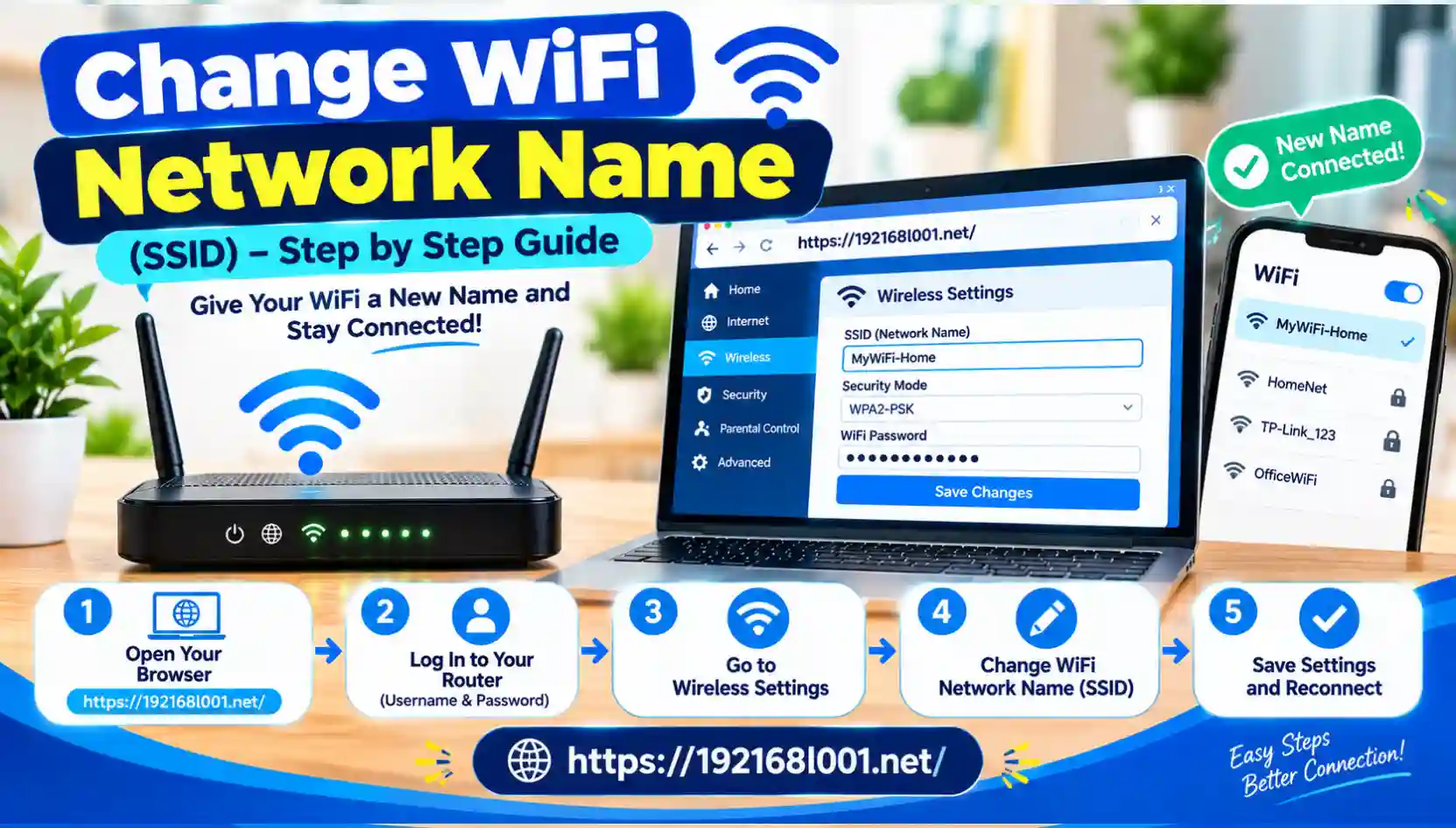
How To Change WiFi Network Name Through Your Router
While the appearance of router interfaces differs, the process below is quite similar across almost all manufacturers.
Connect to Your Router
You need to connect your computer, mobile or tablet to a router first. You may connect on WiFi but an Ethernet connection is better whenever present. When you rename the wireless network while connected over WiFi, your device will typically disconnect once the router saves the new setting.
Open the Router Login Page
Open a web browser — Chrome, Edge, Firefox or Safari.
In a web browser, enter the management address of your router. The address varies depending on the manufacturer and model.
Instead of using a random router IP address, if you aren’t sure what the correct login address is, check your router’s label or official manual.
Sign In to the Admin Panel
Log in with the router admin username and password. Keep in mind that your router admin password and wi-fi password are not necessarily the same thing. WiFi password allows devices to connect to your wireless network. The router configuration dashboard access is controlled by the administrator credentials.
Enter Your New SSID
Erase it and type the name you would like your WiFi networks to have.
For example, you could Change WiFi Network Name:
- TP-Link_A72F
to:
- HomeNetwork
or:
- Office_WiFi
Most router platforms allow an SSID of a maximum of 32 characters. TP-Link and ASUS documentation also mentions a 32 character limit on the WiFi network name for some supported devices. Try to keep the name short and easy to remember.
Save or Apply the Changes
Click on the Save, Apply, Done or similar button in your router interface. While the router saves its new configuration, your wireless network will temporarily vanish. Some routers reboot the wireless radio, or they might completely restart.
How To Change the SSID on a D-Link Router
Afterward, connect with D-Link network; then open your browser. You can access the interface through dlinkrouter, dlinkrouter.x.x (i.e., 192.168.0.1 depending on your router model or other ip address) local, or a 192.168.0.1 IP address. Log in with the user details of your router.
For compatible D-Link units, open Settings > Wi-Fi or the similar wireless network preference page. Get the SSID of Wi-Fi Network and use it to Change WiFi Network Name the current name with your desired name. To save the configuration, click Save. D-Link also advises the wireless clients must re-connect to the newly named SSID after modifying the setting.
How to Change the SSID on NETGEAR Orbi System
Users will have to go ahead with changing their network name via Orbi app and Router browser-based interface.
Plug your phone into the Orbi Network and open the Orbi App. Log in and click on WiFi Settings. Fill out your desired name in the WiFi Network Name (SSID) field, then tap Save.
Connect to the Orbi and go to orbilogin. Visit http://192.168.1.1 or http://mywifiext.com, log in with the router admin password and click Wireless Fill in the name of the new network under Name (SSID), then click Apply.
Change SSID on TP-Link Router
Connect to your TP-Link router and access the management interface. This can be reached on many of the newer models via tplinkwifi. Second, you need to set the IP address for client. This address could be either local website IP (e.g. 192.168.100.1) or can also be net or router local host address.
Next, Sign in and go to Advanced > Wireless > Wireless Settings You might also see Basic > Wireless, depending on your model and firmware.
TP-Link Tether app: You can manage supported TP-Link Tether-compatible routers by opening More > Wi-Fi Settings in the Tether app and tapping the name of the network you’d like to modify.
Conclusion
One of the most basic router hacks you can do is to Change WiFi Network Name (SSID). This allows you to easily identify your wireless connection, tell it apart from nearby networks and better categorize many WiFi bands or networks.
However, the precise menus differ between manufacturers and services; in general terms: connect to the router, open its web interface or mobile app, log in, search for wireless settings, Change WiFi Network Name or SSID responsible for networking devices and their identifiers; is at last save the configuration.